





Project Chimps : Concerns Raised Over Animal Welfare
Community, News April 13, 2020
Blue Ridge, Ga. – Project Chimps, a sanctuary for retired medical research chimpanzees, is coming under fire as former employees and volunteers are speaking out about the lack of care given to the great apes housed at the reserve.
Project Chimps is refuting these claims, stating that this misinformation is being fueled by a “former employee and her personal supporters who do not support Project Chimp’s mission and appear to have a personal agenda”.
Crystal Alba, a former caregiver, went public with information via Facebook earlier this month.
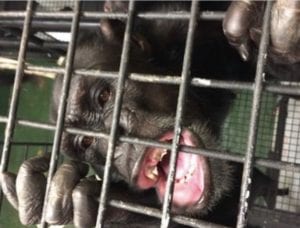
Painelle showing injury to teeth.
Alba says that the specific reason given for being terminated was “failure to report a welfare concern or injury after Painelle’s (a chimp at the sanctuary) teeth were smashed in”. However, Alba feels that she was let go for voicing her concerns about the chimps’ welfare over the past year.
Among these concerns, Alba points out specifically that Project Chimps is lacking proper living conditions and medical care for the chimpanzees.
“I’ve spent three years documenting everything as part of my job and I will continue to use that documentation to be a voice for the chimps,” Alba wrote and added in a later post, “We do NOT want funding pulled from the chimps, but someone needs to be held accountable for allowing management to continue this pattern of neglect while more chimps continue to be added.”
Several employees and volunteers came forward after Alba’s public posting and are backing what the former employee is saying about management being the problem and unfortunately the chimps are the ones that are being hurt through poor decision making.
Lindsay Vanderhoogt, who was hired in April 2016 as part of the foundational staff, said regarding her experience, “From the beginning of my time at PC (Project Chimps) to when I left in February 2018, the sanctuary became a different place. I have many concerns about what’s currently going on at the sanctuary but of course can only speak to my experience and what I have witnessed first hand.”
Vanderhoogt says that her experience with Project Chimps was a lack of overall organization and a lack of support for the chimp care staff: “Now more than ever it seems that instead of the focus being on the chimps and their welfare, it’s now focused on image and pulling in as much money as possible.”
Lucy Becerra, former Donations Coordinator, agrees with Vanderhoogt, “I know a lot of funding was spent on unnecessary promotional marketing to get more funding and made a priority over the chimps and their care.”
Becerra points to a specific example of Project Chimps first Discovery Days stating that there was unnecessary funding for a mass order of the chimp chili recipe cards that were made, and a mass order of shirts of different colors that were not to the Administrations’ liking. Becerra says these shirts were ripped up specifically so that neither the staff nor the public could use or wear them and that these shirts were then thrown away.
“Funding was never an issue, it’s the management and questions on where funding was really being put towards and reported if even being reported,” Becerra said of Project Chimps finances adding, “It was all about presentation and the image they wanted to portray to social media and donors.”
Many of the former employees point to donations being misused to “keep up appearances” instead of going towards the direct care of the chimps.
Among projects being funded, according to former employees, is a “Genius Bar” for interns to sit and work, a classroom, development of a glamping site, and new carts to drive guests around on tours.
Project Chimps Executive Director Ali Crumpacker says that these claims are false and that donations have always been reported and accounted for. Crumpacker also states that the top priority of Project Chimps is the chimpanzees themselves, and that their care comes before promotional advertising.
When asked about the claim of monies not being reported, Crumpacker said, “We are entirely transparent on our finances” and noted that all finance reports can be found on the Project Chimps website.
Concern has also been raised over the Chateau, a brand new building funded by the McGrath Family Foundation of California.
According to Alba problems in this new building include poor drainage, peeling paint, lack of platforms and poorly conceived door placement. Alba says that door placement has actually resulted in chimps from separate groups being able to fight one another.
“Water leaks into the walls causing moldy insulation,” Alba said, “Speaking of porches, they get almost no sunlight due to a solid platform built over them, intended to be a viewing area for donors.”
“That’s why we have a full time maintenance team,” Crumpacker refuted these claims saying like any building there will be issues, but that Project Chimps employees a full time maintenance team for this purpose and that any issues that arise are dealt with in a timely fashion.
Some former employees also claim that the chimps are not receiving proper nutrition and that meals are not being customized for a chimp’s individual health needs.
An example given of this is Precious, an older female, who arrived at Project Chimps in August 2018 with known kidney disease. According to Alba, in over a year no physical or lab work was done to monitor Precious’ health and while a urinalysis in March of 2020 showed high protein levels, nothing was done.
“In the meantime, she’s lost weight, muscle, and hair,” Alba spoke of Precious, “We continue to use her kidney disease in social media posts to ask for donations, but we have no idea if/how it’s progressing and there are no plans to find out.”
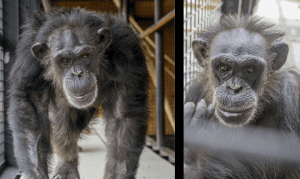
(L) Precious soon after arriving to Project Chimps (R) A recent photo of Precious
“Recently we switched to a different chow because it’s cheaper and this coincided with a lot of our weight loss/hair loss/parasite issues,” Alba wrote about the nutritional care given at Project Chimps, “It’s higher in starch which contributes to proliferation of balantidium, a common parasite among the PC chimps.”
Current Chimpanzee Caregiver Tawnya Williams went on record to say the claims about nutrition and chimp Precious are completely false.
Williams, who has been with Project Chimps for three years, has 13 years of primate experience and 20 years in animal care. Before coming to Project Chimps, Williams served as Primary Chimpanzee Keeper at the Chattanooga Zoo.
“We are very careful,” Williams said of monitoring food intake.
Williams spoke of one of the more common problems faced when feeding the chimpanzees. Lower ranking chimps can sometimes have their food taken by higher ranking chimps in the group: “If a chimp does get its food stolen. We problem solve that.”
Williams said that not only is each chimp’s food monitored for proper caloric and nutritional intake but also that caregivers will often separate through coaxing the lower ranking members of a group during feeding to make sure that they are getting exactly what they need.
Williams addressed Precious in particular saying that she is being monitored and is receiving the proper nutritional routine for her condition and at this time her condition is not clinical.
Veterinary Care, or lack there of, is what is most troubling to these individuals who have stepped forward about the welfare of the chimps.
“We originally had two veterinarians on staff, both with years of chimp experience. Now, there is a dog and cat vet at the sanctuary who is managing 79 chimps with absolutely no chimp experience,” Vanderhoogt said of the specialized care the chimps are supposed to be receiving.
Dr. Jim McClearen joined Project Chimps in 2017 as the consulting veterinarian. McClearen works at Tri-County Animal Clinic, a private practice for companion animals.
Also in charge of chimpanzee health is Laura Mayo, whose official title with Project Chimps is Manager of Chimpanzee Care. According to the Project Chimps website, Mayo is a former Assistant Curator of Primates for Zoo Atlanta and joined Project Chimps in 2016.
Many concerns have arisen, from former employees and volunteers, about the lack of medical attention given to the chimps.
The following examples of medical care and documentation were given to FetchYourNews by both current and former staff. Project Chimps replied to each inquiry about these specific chimps and also provided photographic documentation.
Kennedy
Concern : Kennedy is a 12 year old male that is showing extreme hair loss. According to sources McClearen and Mayo claim it is seasonal shedding and nervous plucking, but staff say that the hair loss didn’t begin until Kennedy moved to the Chateau and that no one has witnessed “plucking” which is associated with nervous chimpanzee behavior.
Some believe that the hair loss could be due to a nutritional need, a vitamin deficiency, or lack of sunlight from being housed in the Chateau. All agree that medical caregivers have shown indifference and have not come up with a plan of treatment for Kennedy.
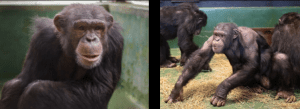
(L) Kennedy in March 2018 (R) Recent photo of Kennedy
Project Chimps Response : Chimpanzee Caregiver Tawnya Williams, when asked about the lack of veterinary care, replied that she was confident in the care that has been given to the chimps and McClearen’s ability to provide this care.
Williams stated that McClearen is on site twice a week, and more if needed, and that he is constantly in contact with other vets and chimpanzee specialists to ensure that the route he is administering is the best route to take.
To understand Kennedy’s hair loss, according to Williams, you have to understand the dynamics of chimpanzees in groups.
“A lot of times you are going to see plucking on higher ranking chimps. Especially if they are working on group dynamics. He is a higher ranking chimp,” Williams stated and added, “Unfortunately for him, it gets a little overgrooming.”
Williams says that the grooming is coming from lower ranking members of the group, and that it is actually a good sign that Kennedy is allowing them to do this as it promotes bonding.
Jermaine
Concern : Jermaine is a 31 year old male who had received a laceration on the bottom of his right foot in Jan. 2020. Jermaine was put on Ceftriaxone, an antibiotic that treats a broad spectrum of infections.
According to Alba, Jermaine’s wound did not respond to this line of antibiotics and McClearen refused to try a new antibiotic.
Alba did say that Jermaine was eventually prescribed to Tramadol for pain. McClearen said to administer 700mg of Tramadol per day. Alba says that the pain medication protocol the vet put in the Project Chimps manual recommends is Tramadol: 5-10mg/kg PO every 8-12 hours. According to this information, Jermaine was being prescribed an overdose of medication.

Four photos showing the progression of Jermaine’s wound.
Project Chimps Response : Crumpacker says that the pictures and allegations of Jermaine only show a partial picture and that the chimp was properly monitored and did receive proper medical care.
Project Chimps provided FetchYourNews with this photo depicting Jermaine’s foot as it is in the present day. The foot appears healed with a only a scar left.
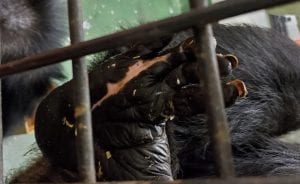
Jermaine’s wound in a recent photo.
Arielle
Concern : Arielle is a nine year old female that began hair plucking after arriving at Project Chimps. Sources tell FetchYourNews that Arielle showed no signs of this abnormal behavior when arriving but since first displaying the behavior, her condition continues to worsen.
Regarding this behavior, sources say that Administration at Project Chimps will write it off as “she’s always done that” or “there is nothing you can do about plucking”.
“She isn’t bullied and has close friendships with the older females in her group,” Alba said of Arielle and her condition, “Her group will be integrated with a group of males in the Spring and I worry what that stress will do to her.”
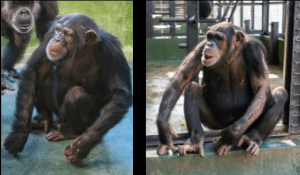
(L) Arielle in Nov. 2019 (R) Arielle in Feb. 2020
Project Chimps Response : “These types of things take awhile when they go through psychological trauma. Just like in people, moving locations can trigger that,” Crumpacker said of Arielle and noted that Arielle is self-plucking. “It gets resolved and then the hair grows back.”
Williams gave more insight into Arielle stating that she was actually part of the transport team that brought Arielle in: “She is very attached to their alpha female Lindsey, and Lindsey is going into the habitat regularly, and Arielle gets stressed out and little bit worried because Lindsey is going out.”
This is an abnormal behavior that is commonly seen in chimps that are not in the wild according to Williams: “Her plucking is stress related, hers is basically self-soothing.”
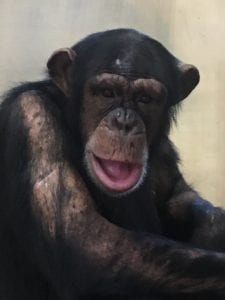
Arielle photographed on March 29, 2020 showing hair growing back on shoulders and arms.
Eddie
Concern : Eddie, who will turn 16 this May, got into a fight in Sept. 2019 and sustained a facial injury as a result. Eddie’s caregiver, who had primate experience, noted the wound as “severe”.
The United States Department of Agriculture (USDA) did an inspection of Project Chimps during this time and according to former employees questioned Mayo as to why this wound was only being treated with Ibuprofen.
Sources told FetchYourNews that the wound never healed properly and that Eddie is permanently disfigured.
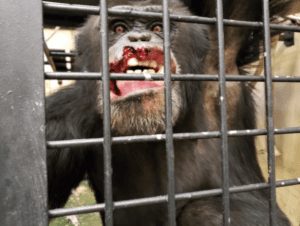
Eddie’s facial wound.
Project Chimps Response : “Chimpanzees do get wounds. It’s just like any other animal or human,” Crumpacker said and added that unlike other animals stitches are usually not an option.
According to Crumpacker, because of a chimpanzee’s intelligence and their nimble fingers, they will just remove the stitches shortly after they are put in.
Crumpacker states that Eddie’s wound was properly treated and Project Chimps provided FetchYourNews with a current photo of Eddie. Crumpacker also provided the USDA inspection conclusion from this trip citing that Project Chimps was in full compliance.
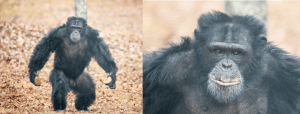
Eddie after wound healing.
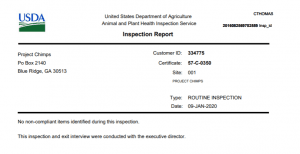
USDA findings from Jan. 2020 visit to Project Chimps.
PETA (People for the Ethical Treatment of Animals) became involved in Jan. 2020 with advocating for the welfare of the Project Chimps’ chimpanzees.
Senior Vice President of PETA Kathy Guillermo, who works in the Laboratory Investigations Department, spoke with FetchYourNews regarding the allegations against Project Chimps.
Guillermo confirmed that several employees and volunteers spoke with PETA about the veterinary care and conditions some of the chimps were living in: “We were really disturbed by what we heard.”
Guillermo says that PETA has no authority to investigate Project Chimps, but that they did reach out to the Project Chimps Board of Directors and to the Humane Society of the United States (HSUS) since four of the board members work for HSUS.
“We had no response from the Humane Society at all until about a week ago,” Guillermo said and added that initially Project Chimps President Bruce Wagman had agreed to meet with PETA and discuss the allegations, but later refused to meet: “We were told there was an internal investigation and everything was fine.”
“This has just been incredibly frustrating. When an animal needs help, you need to get that animal help and there is no excuse for delay,” Guillermo said of the response received from Project Chimps and the HSUS. “No reason for the kind of silence that we were met with from the Humane Society of the United States.”
An email from Wagman that was forwarded to employees by Project Chimps Executive Director Ali Crumpacker, dated Jan. 30, 2020, backs up that Project Chimps had conducted an internal investigation.
In part the email reads:
“As some of you may know, concerns have been raised about some of our practices. We began an investigation earlier in the month and we will respond to the specific individuals who raised these concerns. We conducted an internal review and also consulted with outside experts in the veterinary and chimpanzee welfare arena. What we discovered when lining up the facts with the claims, was that almost all of the concerns were either based on false statements, unfair mischaracterizations of events, or, at best, honest differences of opinion about our practices and protocols. We found zero actual problems in the chimpanzee welfare area and zero valid concerns with our veterinary efforts.”
This email goes on to outline a review of the nondisclosure agreement (NDA) that employees and volunteers sign upon working for or with Project Chimps. It outlines their open door policy, stating that complaints need to be made to direct supervisors or to the Compliance Officer.
Wagman states in the email that these two policies are in place to “protect Project Chimps from having third party groups, which do not have the full picture or all of the facts or may have agendas of their own, from attacking Project Chimps based on the kind of false information and mischaracterizations that we have seen in the reports we received.”
“PETA has no authority to conduct an investigation there, so we turned the allegations over to the Global Federation of Animal Sanctuaries (GFAS), which is the body that accredits sanctuaries and accredited Project Chimps,” Guillermo stated of PETA’s efforts.
Guillermo says that she has been told that GFAS has looked into the allegations against Project Chimps and has made recommendations for improvements.
Guillermo spoke of the chimps’ pasts in a lab and said, “The last thing anybody wants to see is these animals put in conditions that are anything less than optimal.”
GFAS Executive Director Valerie Taylor also spoke with FetchYourNews regarding the concern analysis performed on Project Chimps.
Taylor says that GFAS became involved in Feb. 2020 after whistleblower complaints came to the organization via GFAS’ website: “Our standard operating procedure when we receive those concern forms via our website is always to follow up and conduct an analysis.”
Project Chimps has been accredited by GFAS since Jan. 2018.
Taylor acknowledged that recommendations had been made to Project Chimps and said, “It is really rare for any accredited sanctuary, that goes through our GFAS process and goes before a GFAS accreditation committee, to not come away from that without recommendations.”
“We certainly didn’t find anything that was an emergency as far as animal welfare and animal health,” Taylor said of her agency’s findings. “What we found is just some systems that need to be put into place so that it will help the sanctuary, particularly as they look to increase their population of animals retiring out of laboratories.”
When asked about her overall feelings on the practices of Project Chimps, Taylor said there were “no concerns for animal or human safety there.”
Executive Director Ali Crumpacker sent out a statement in a letter to volunteers, after concerns began to be made, that reads in part:
“It is clear that the bulk of what has been alleged to date is false. The rest appears to be based on partial information, half-truths, gross misinterpretations presented out of context to PETA. The allegations originated with a small group of detractors with their own agenda who no longer support our mission.”
“We are confident we will manage to clear all of the allegations made against us. Our major donors have already signaled unflagging support. As volunteers your continued support is also essential to helping us achieve that end. Thank you.”
Crumpacker did confirm that Project Chimps had already been proactively looking for a new Director of Chimpanzee Care (veterinarian) after McClearen announced that he would be retiring. There are candidates that Project Chimps has been in contact with but could not provide more information at this time.
According to Guillermo many of the complaints could be fixed by simply having experts on the grounds to care for the chimps.
Those who are speaking out are calling for the same actions as Guillermo suggests and a change in leadership.
“What I believe needs to happen at Project Chimps is structural change,” former employee Vanderhoogt said, adding, “The Board needs to be refreshed and the leadership at the organization needs to be removed. People with actual chimp experience need to be put in place so that the chimps can have people working on their behalf who truly understand the issues of working with chimpanzees.”
Current employees, like Williams who spoke on the record, feel that the leadership at Project Chimps is doing a great job: “They are more open to input from employees than most places that I’ve worked. They definitely took all of the allegations seriously. I have no questions about Project Chimps being the best welfare for the chimps.”
As for Painelle, who was pictured at the beginning of this article having suffered a mouth wound, according to both Crumpacker and Williams she is doing fine and resolved the issue on her own.
Williams said, after noting that Project Chimps was monitoring her condition closely, “She did take care of them herself. It was the best for her welfare for a whole bunch of different reasons.”
Sedation, according to Williams, is difficult for a chimpanzee because it is a scary experience for the chimp itself and it also disrupts dynamics having the chimp removed and then reintroduced to the group. Williams also noted that in the wild chimpanzees due tend to and take care of their wounds on their own.
After concerns were raised via social media, Project Chimps did have Jocelyn Bezner, VMD, a primate consultant, visit the sanctuary and examine the 79 chimpanzees housed there. Bezner released the following statement about her findings:
“I have spent the past three days at Project Chimps assessing each individual chimpanzee and find everyone to be healthy and well cared for. I have no medical concerns at this time and see minimal abnormal behaviors. Every organization has room for improvement and I look forward to helping Project Chimps provide the best quality of veterinary care to their residents.”
Author

4 Comments
Hello. Thanks for the article. You have your photo captions backwards for Precious, Kennedy, and Arielle. The photos on the left (L) are the “befores” and the photos on the right (R) are the recent photos.
I find it hard to understand that 3 former employees (1 who was just terminated for animal welfare violations of all things!), are able to make accusations that national animal welfare groups like GFAS & HSUS, plus current staff and volunteers are proving are untrue. I feel that there really is no story here. I have followed and witnessed the amazing work Project Chimps does for each and every chimp in their care. The fact that someone would even believe they are mistreating the chimps is disappointing.
Wasnt Dr Bezner fired from Save the Chimps? Bc a chimp starved to death under her care? I’m pretty sure she’s looking for a job, and would say whatever it takes to get one at Project Chimps: just what they need, more sub par care. Everyone that has something positive to say is in HSUS pocket. That’s why they ignored PETA. How about stop using the funding for tshirts and develop more of the 236 acres that belongs to the chimps for them. Currently they share 6 acres. Meaning they get maybe 2-3 hours a week. Each. Stop using funds for “glamping” and golf carts. Management needs an overhaul. Also, have you seen how much money the people that run that place are makinb!?!! It’s a public record. It’s insane to be paid that much to NOT do your job…
This article very much upset me. I have been a volunteer at Project Chimps for almost 3 years. I have worked extensively in food preparation and also in chimp care where we clean the chimp villas, as their houses are known. Let me say initially that I have never seen ANYTHING but exemplary care given to these chimps. Having spent a significant amount of time with the staff, I have witnessed nothing but true affection and love toward these animals. The staff speaks of the chimps like they are their own children, laughing about their antics and commiserating over any concerns they see. Yes, there are occasional chimp injuries as they romp in the woods and wrestle with each other, but injuries are always cared for. These creatures have never lived in a natural, communal situation until coming to Project Chimps. They came to us after a life of living in a cage. There will be issues as they continue to work out the the normal hierarchy seen in a wild pack. That adjustment can understandably be stressful at times.
The food we prepare for them is carefully planned and extremely varied. We also make different daily fun puzzle packs which the chimps problem solve to find the treats inside. We strive constantly to try to stimulate their brains. They are so intelligent! The quality of the food is as good as I eat at home with as many variations in their fruit and vegetables, nuts and seeds as you have in your diet. The villas are scrubbed down daily and fresh blankets and straw are spread about so every night the chimps can make a clean nest in the fire hose hammocks that hang in their sleeping rooms (which have AC and heat, BTW). Musicians have come in and played for them, which the chimps enjoyed. Bins of balls have been brought in for them to roll and play in (you can see this on YouTube). The outside areas have big climbing structures for them to play on when they come outside for fresh air. The list goes on and on of what this sanctuary offers to these chimps. The point is, it is the chimps’ choice to come out or stay inside as they please.
Just today, as we worked in the kitchen, we watched a family unit lounge in the sun with their eyes closed while other chimps climbed up on top of a structure to eat their snacks. Ask the almost 300 volunteers who give their time to this sanctuary. We will tell you that these chimps are loved and well care for. Speaking of volunteers, we receive extensive, ongoing training in infection control, safety and chimp behavior among other topics, to work here. We must all fully vaccinated. To become a volunteer here is something you truly have to want to do. It is an exercise in showing your love for the animals of this sanctuary. In closing, may I add that for the not-so-great pay the staff receives (as we run almost solely on donations), those that work here also do it for the love of these outstandingly grand creatures. These people are all heroes in my book.