





Blue Ridge City Council Talks Master Plan, Meeting
News September 4, 2015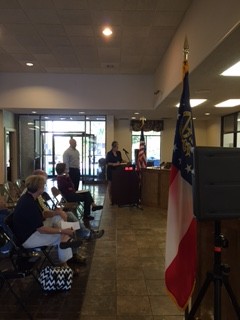
The definition of a meeting was brought up once again on the agenda by council woman Rhonda Thomas at the Blue Ridge City Council’s “Meeting Workshop” on September 1.
Councilwoman Angie Arp pointed out a workshop is still a meeting and Mayor Donna Whitener pointed out that any discussion in a workshop can be tabled for action for the next meeting. The Council decided (with Councilwoman Thomas absent) to change the workshop to a meeting.
Councilwoman Arp and Councilman Rodney Kendall also asked for a clarification on how phase one of the master plan will be funded. Luckily, Grant writer Angela Steedley and engineer Matt Smith of Carter and Sloope Consulting Engineers were there to answer and make a presentation.
Steedley emphasized the need to begin the process of the projects that will be paid for by grants. This will include preliminary engineering work to determine what to repair. The city will also need to invest in preliminary design work as well as an environmental review. At the last meeting, the council approved Request for Qualifications for an engineer and an architect that would handle designing and building of the projects. Steedley said that since preliminary work should begin immediately, they should go ahead and hire an engineer and a design architect immediately. The city can have a request for bids closer to the actual construction for a build architect. Steedley also said that even if the grant is turned down, this work should be done and can be used for other grants. She also mentioned that parts of previous environmental surveys would be able to be used again.
Steedley also emphasized the importance of getting the information from surveys given to Blue Ridge business owners concerning economic impact of their business. This information will help determine the type of funding that is available to the city.
On financing Steedly said, “Basically everything hedges on of the number of existing jobs, existing private investment, sales tax revenue, payroll and/or goods, and then also new investment and new jobs that would be created.”
The Council reversed the motion for Request for Qualifications and decided to hire Carter and Sloope as engineers and R Design Works as the design architects. Both have done work for the city before.
There are 3 grants for which the city is applying. They are all matching grants. First is the Appalachian Regional Commission Commercial Loan fund, which will be used for commercial redevelopment purposes. Next is the Redevelopment Loan Fund Grant which will be used for bathrooms near the depot. A state revolving fund or loan fund will be used for improvements to sewer and storm drains. Smith said that environmental clearance will be needed for the storm drain project. He estimates it will take 60 days for the environmental clearance to be approved.
If the grants aren’t approved there are other sources of income to complete these projects. It will depend on how much investment and job creation would be generated from the projects. First the city could take out a loan, which would require payments, and showing the city’s ability to repay the loan. Another possible source for the projects would be a business improvement district or a community improvement district, which would require property owners agree to pay an additional percentage on their tax.
This additional percentage would go towards redevelopment. The last option is municipal bonds, which Mayor Whitener said, “we’re probably going to have to go back to [bonds] maybe with our sewer expansion.”
Phase II was also discussed, which will include improvements to East Main Street. The main street improvements will be funded by a Special Local Option Sales Tax. Phase II should be able to begin fairly quickly after its preliminary phase.
The council also approved of obtaining a quote from Matchpoint for water leak detection at various locations throughout the city, including Highway 5 and in downtown. Water Loss Control funds will be used to pay for this. Other expenditures approved during the meeting include a purchase of 50 tons of Salt for the road, at $173 a ton, and renovating the stairs outside of Angela DeLorme’s office. The renovation will add a step, replace slanted steps, and put a railing at the steps.
Mayor Whitener said, “Those steps slant you forward and are a little bit dangerous in my opinion. There needs to be a railing. I have seen kids getting off the bus and using those.”
The council discussed skid steer loader quotes, but decided to table it until further review. The council also briefly discussed imposing restrictions on mobile vendors. Location of mobile vendors, the number of mobile vendors, what type of vendors to allow, health regulations, and even times for vendors to sell were all discussed. The council decided to table this until further research into other cities’ practices with mobile vendors could be researched.
Many questions were answered about the master plan and funding at this meeting, which in turn helped the city progress with its vision of an infrastructure sound downtown.
Leave a comment