





Council Member Michael Eaton Talks about the Swan
Featured Stories, News October 25, 2011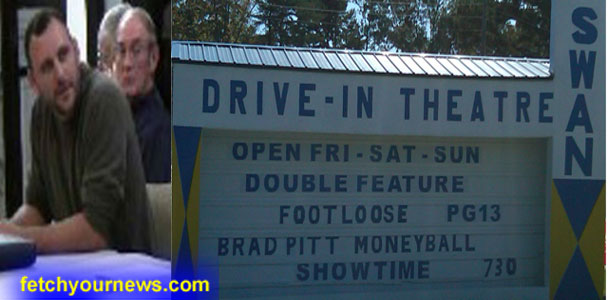
“The funniest thing about the whole thing is that we’re arguing over 100 percent profit.”
One of the more strident voices in the Swan Theatre debate is Parks Commissioner and Blue Ridge City Council member Michael Eaton. In the midst of a contentious council, Eaton appears to champion dauntless support for sustaining the Swan for years to come. FYN recently had the opportunity to sit down with Eaton to discuss the Swan Theatre situation at length.
“The property the drive-in sits on was donated (to the city) in 1932,”
he says, by the Georgia Baptist Assembly. Later, in 1955, Jack Jones Sr. along with a group of investors built a drive-in theatre on the land, building all structures, including the screen and buildings.
“At that point in time, they signed a lease with the city,”
Eaton explains. The lease, though, was only a land lease. The lease had a renewal period in 1979, which Jones signed and which was valid through 2003. Eaton states that in 2003, Helen Jones, widow of Jack Jones Sr., chose not to renew the lease. Here, Steve Setser entered the lease as the operator of the theatre. But, this lease was simply an extension of the previous lease and only lasted five years, ending in 2008.
“The city entered into another lease in 2009,”
he says. This was good for 20 years, expiring in 2013. According to the lease, Setser would pay a rent of $500 per month for the first ten years and the next ten years were to be determined, which means that the terms of the second ten years could be negotiated.
Eaton explains that Setser started working in the drive-in at the age of 15. Then in 1989, he started running the drive-in under the Jones 1979 lease. This lease, though, has a reversion clause, where the buildings on the land reverted to the city in 2003. So, as of 2003, the city of Blue Ridge effectively took ownership of the buildings and structures located on the drive-in’s property. This went undetected by the city until spring of this year, following the death of Helen Jones, widow of Jack Jones Jr., at the end of 2010.
According to Eaton, Setser believed ownership of the buildings would be transferred to him in Widow Jones’ will. Jack Jones Jr., son of Jack and Helen, likewise thought he would receive ownership of the buildings as well. Of course, neither party could receive ownership of the buildings, since legally the city owned them. Eaton said that when the city discovered it owned the buildings around April or March of this year, he knew that the city needed a new lease to account for the fate of the land and the city’s building ownership. At this time, Eaton noted he started working on the new lease and extended the insurance to cover the buildings, which included all structures on the premises as well, including the screen. When Setser found out about the insurance, he decided to reimburse the city for the payments, $35 a month, which he paid for the rest of 2011, the monthly cost of what the city paid for insurance.
“(In) the new lease,” Eaton says, “he (Setser) has to run it as a drive-in theatre; he has to up-keep those buildings; anything that goes wrong out there, he has to take care of it. He can’t ask the city for anything, either to mow the grass or trim the trees—he has to up-keep everything.”
In the new lease that Eaton’s been working on since the spring, the rent for the land is still $500 a month, but over the next 10 years increases to $750 a month and increases in the last five years to $1100. When he designed this schedule, he explained that he took inflation into consideration, but did not want to increase the price of the rent every year. An annual increase, Eaton says, would drive up ticket and concession prices and he did not want to do that.
According to Eaton, as the lease stands now, Setser could close the drive-in at anytime and the city has to pay the insurance on the buildings. In Eaton’s new lease, the reversion clause is reversed, so that the responsibility of the buildings returns to Setser. This means that Setser pays the insurance on the building, is responsible for the up-keep of the land and pays the city a monthly rent of $500, which increases to $750 over the next ten years. Eaton asserts that the city has nothing invested in the land—it was donated to the city in 1932—and nothing invested in the structures, since, ownership of the structures revert back to Setser.
“The funniest thing about the whole thing,” he says, “is that we’re arguing over 100 percent profit.”
Here, Eaton is referring to some criticisms by other council members. At the last city council meeting, Mayor Donna Whitener commented that other land owners in the city are complaining to her that Setser pays only $500 in rent a month, while they are paying the higher market value. When asked about the low rent of the drive-in in comparison to other businesses, Eaton asks what’s fair? One possible answer is: market value. When asked if the drive-in property has ever been assessed, Eaton said he was not sure, but defended Setser’s low rent.
“If there wasn’t a drive-in out there, I’m not sure what we could use that property for…I don’t know who would want to rent a piece of property out there: commercial (property) is dead in this county right now,”
Eaton says. His argument is that the property would go to waste if the drive-in wasn’t there and, perhaps more important, the county would lose money. Eaton fears that raising Setser’s rent all at once or too drastically would put him out of business and close down one four drive-ins remaining in the state.
Another criticism of Setser’s low rent is the issue of affordability. His detractors assert that Setser makes enough money to pay a higher rent; some claim $30,000 a month. This figure is based on ticket prices, the number of moviegoers (car capacity of the theatre) and concession sales. According to Eaton, the Swan holds approximately 400 cars. Setser, though, does not charge by the car, but by the person, at $6 a head. Also, concession prices are a little lower than at your average theatre. But, Eaton argues that Setser does not make as much money as most people think. Eaton suggests that moviegoers sneak in food so they do not buy food at the theatre’s concession stand. Also, when Setser runs a new movie, he is required to return 70 to 90 percent of ticket sales back to the film company and each week the movie is run, the percentage decreases.
Eaton says that the new lease has been approved by the county attorney and is legally sound and has a life of 26 years. He has been criticized over the length of the lease, but defends the length as a way to preserve the theatre for years to come, which most people agree is a boon to the community.
In order for this lease to be binding, it requires a majority vote from the council—at least three signatures—and the mayor’s signature. However, if the mayor refuses to sign, mayor pro tempore Wayne Huffman can sign it, making the lease legally binding.
The fate of the Swan Drive-in Theatre hangs in the balance and will soon be determined in the weeks and months to come. The Swan will either soar or dive. FYN will follow her flight.